
Criminal Court Records in Hancock County
A criminal court record is the case file a court keeps once a criminal charge is formally lodged. It is built and held by the clerk who serves that court. For felony cases, the keeper is the Hancock County Circuit Clerk, whose office sits in the courthouse at 152 Main Street, Suite B, in Bay St. Louis. The file collects every paper tied to the case. That includes the charging document, the plea, motions, court orders, the outcome, and any sentence the judge hands down.
Not every criminal record lives in one place. Hancock County uses more than one court for criminal matters. Justice Court and the municipal courts of Bay St. Louis, Waveland, and Diamondhead handle misdemeanors, initial appearances, and the early steps of a felony. Circuit Court handles felonies after a grand jury acts. So a single name can have entries in two courts at once. Knowing which court holds which stage is the first step in reading a Hancock County criminal court record correctly.
The charges themselves get a closer look on the Hancock County arrest and court charge records resource, while the full set of civil and criminal filings is covered under Hancock County court records.
The Hancock County Felony Pathway
A felony does not start in Circuit Court. It starts in a lower court. Which one depends on the arresting agency. A charge from the Sheriff's Office or a state agency usually begins in Justice Court at the Public Safety Complex on Highway 90. A charge from a city police department begins in that city's municipal court. The lower court handles the initial appearance, sets bond, and holds any preliminary hearing.
The case then heads to the grand jury. If the grand jury returns an indictment, the felony is bound over and moves to Hancock County Circuit Court. From that point the Circuit Clerk keeps the criminal case file, and the District Attorney prosecutes. Circuit Court is part of Mississippi's coastal circuit, and its judges hear felony trials, civil suits, and appeals from the lower courts. The Mississippi Judiciary explains the role of these lower courts in plain terms.
The Mississippi Judiciary Justice Court page outlines the jurisdiction of the courts where most felonies first appear.
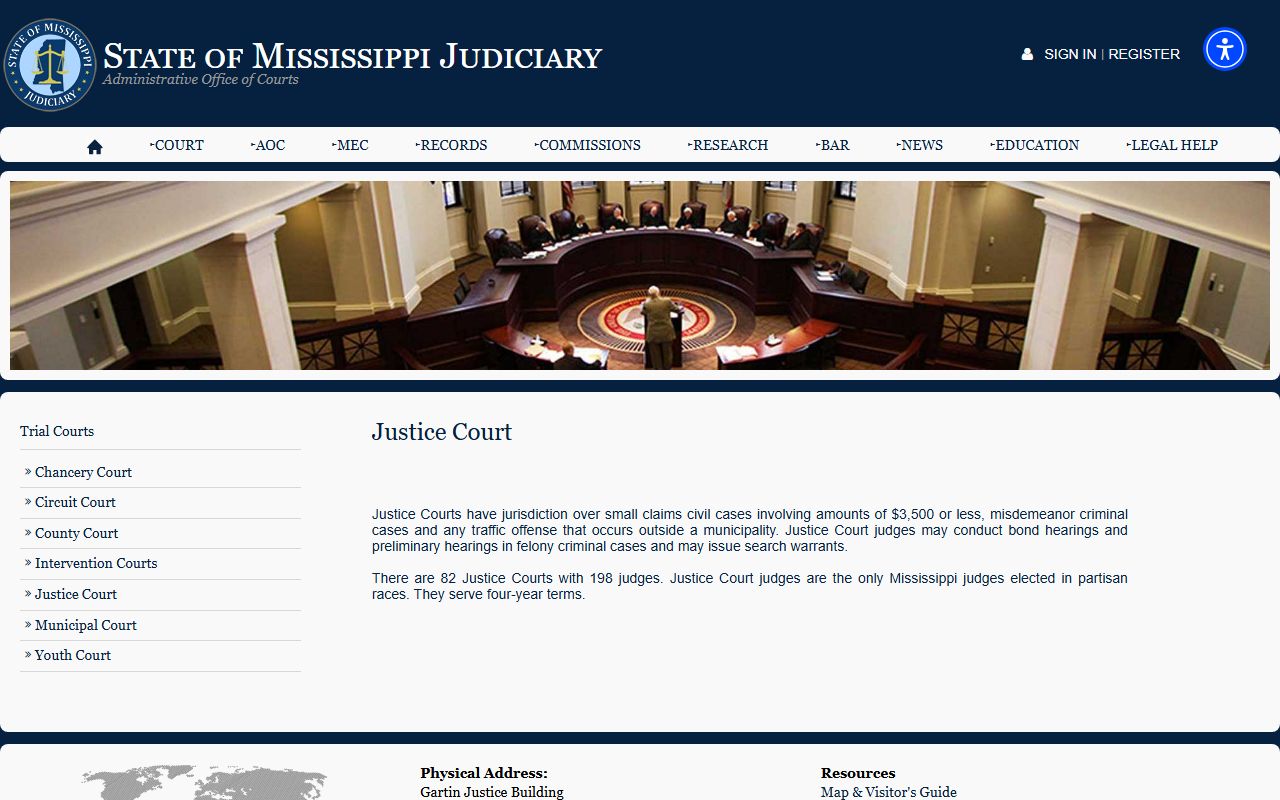
That page confirms Justice Court hears misdemeanors and felony preliminaries before a case can rise to the circuit level. Until a grand jury acts, the early record stays in the lower court, not in the circuit criminal index.
How to Search Hancock County Criminal Court Records
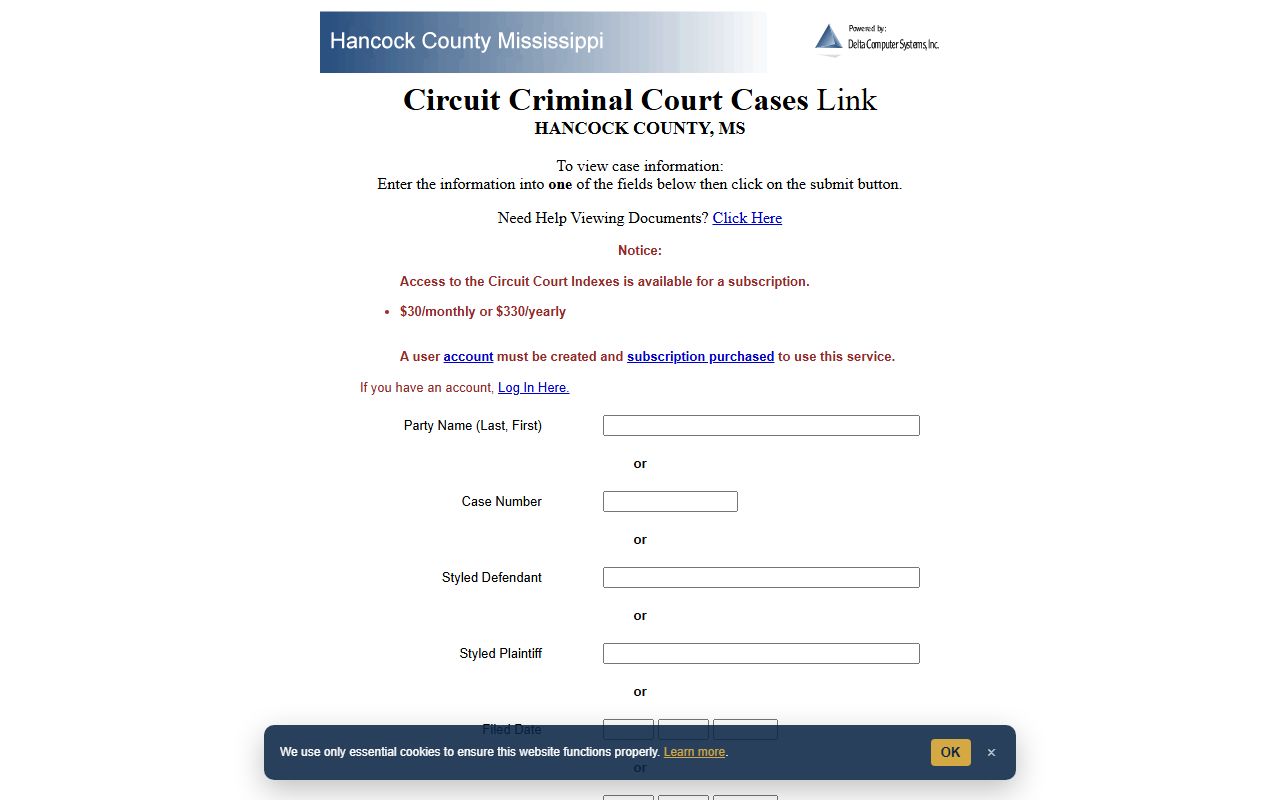
The main online route for circuit cases is Delta Computer Systems, the vendor that hosts the Hancock County online records search. It offers a Circuit Criminal search for post-indictment felony case files. The landing page warns that online data can lag the courthouse, can have gaps, and is not the official record. Access to the circuit indexes is subscription based, set at 30 dollars per month or 330 dollars per year. The search fields are visible to all, but full results sit behind a login.
- Open the Delta Computer Systems Hancock County landing page and choose the Circuit Criminal search link.
- Search by party name in last, first order, or enter a case or file number if you have one.
- Narrow the result with the filed date, final disposition date, or docket book and page.
- Open the matching case to read the index entries, the charge, and the disposition.
- Request a certified copy from the Circuit Clerk when you need the official document.
The image below comes straight from the live circuit criminal search form. The Hancock County Circuit Criminal Court Cases search shows the exact fields a user fills in.
Online access is only one channel. When a record is not online, is older, or is locked behind the subscription, the clerk is the fallback. The Circuit Clerk runs criminal and civil record checks for a fee, and certified copies come from the same counter. For records that do not fit cleanly with any clerk, the county public records request form goes to the County Administrator, who must respond within seven working days.
Circuit Criminal Search Fields
The Delta Circuit Criminal form accepts several identifiers. A user fills any one of the listed fields, then submits. The exact formats are not all published, so the safest approach is to start with the most precise identifier you have, such as a case number, and fall back to a name search if that returns nothing.
| Field Label | Type | Required | Format Notes |
|---|---|---|---|
| Party Name (Last, First) | Text | One of the listed fields | Use last, first order. |
| Case Number | Text | One of the listed fields | Exact format not published. |
| Styled Defendant | Text | One of the listed fields | Defendant name or caption. |
| Styled Plaintiff | Text | One of the listed fields | Often the State, if styled that way. |
| Filed Date | Date/Text | One of the listed fields | Date format not stated. |
| Final Disposition Date | Date/Text | One of the listed fields | Date format not stated. |
| Docket (Book/Page) | Text | One of the listed fields | Book and page reference. |
| File Number | Text | One of the listed fields | File number if known. |
Note: the Delta index is a finding aid, so verify any hit against the courthouse file before relying on it for a legal or formal purpose.
Stages of a Hancock County Criminal Case
A criminal case moves through set stages, and each one adds papers to the file. The record reads like a timeline. You can often trace the whole case just by reading the entries in order, from the first charge to the final order.
Case flow: Charges Filed › Arraignment › Pretrial and Motions › Plea or Trial › Disposition › Sentencing
| Stage | What Happens |
|---|---|
| Charges Filed | A charging affidavit or grand jury indictment opens the case and names the charge. |
| Arraignment | The charge is read and the defendant enters a plea, or files a written waiver of arraignment. |
| Pretrial and Motions | Both sides file motions, exchange discovery, and the court sets dates and rules on requests. |
| Plea or Trial | The case ends in a plea, or goes to trial before a judge or jury for a verdict. |
| Disposition | The outcome is recorded, whether guilty, not guilty, dismissed, or otherwise resolved. |
| Sentencing | After a conviction the judge orders the sentence, which may include jail, probation, or fines. |
What a Hancock County Criminal Court Record Shows
A circuit criminal file is more than a name and a charge. It holds the indictment, the arraignment or its waiver, the plea, trial settings, motions, court orders, the disposition, the sentence, probation terms, any bond revocation, and appeal papers. Online indexes tend to show the key fields, while the full document or image may be gated, courthouse only, or redacted. The table breaks down the fields most readers look for.
| Field | What It Shows |
|---|---|
| Case Number | The court-assigned identifier that ties every filing to one case. |
| Defendant | The person charged, listed as styled in the case caption. |
| Charges | The offense as filed, by indictment or charging affidavit, with its level. |
| Plea | The defendant's formal answer, such as guilty or not guilty. |
| Disposition | The outcome of each charge, from dismissal to conviction. |
| Sentence | The punishment ordered after a conviction, with any probation terms. |
Some fields never appear in a public view. Social Security numbers, financial account data, juvenile names, medical details, and sealed exhibits are redacted or withheld. So a public file can read as complete while still leaving protected items out.
Prosecution and Appointed Counsel
The District Attorney prosecutes felonies in Hancock County Circuit Court. The DA office sits at 152 Main Street, Suite D, in Bay St. Louis. Discovery for an indicted case comes from that office, and the prosecution team handles the state's side from grand jury through sentencing. Many filings in a criminal court file are signed by the DA or an assistant district attorney.
Defendants who cannot afford a lawyer can ask the court for one. A felony defendant usually has an initial appearance within 48 hours of arrest. At that hearing the Justice Court judge or Municipal Judge asks whether the person can hire an attorney. If not, the defendant fills out a Petition for Court Appointed Attorney under oath. Hancock County uses three private attorneys under contract to serve as court-appointed counsel.
- The petition is sworn before the court, the clerk, or a notary.
- A defendant in jail is screened by the judge at the initial appearance.
- A defendant out on bond can get the petition from the Circuit Clerk and file it in person or by mail.
- Once indicted, the case lands on the Circuit Court docket and the judge reviews attorney status.
Federal criminal cases follow a separate track and never enter the Hancock County circuit file. They are prosecuted by the United States Attorney's Office for the Southern District of Mississippi. The U.S. Attorney's Office for the Southern District of Mississippi handles federal charges that arise in the county.
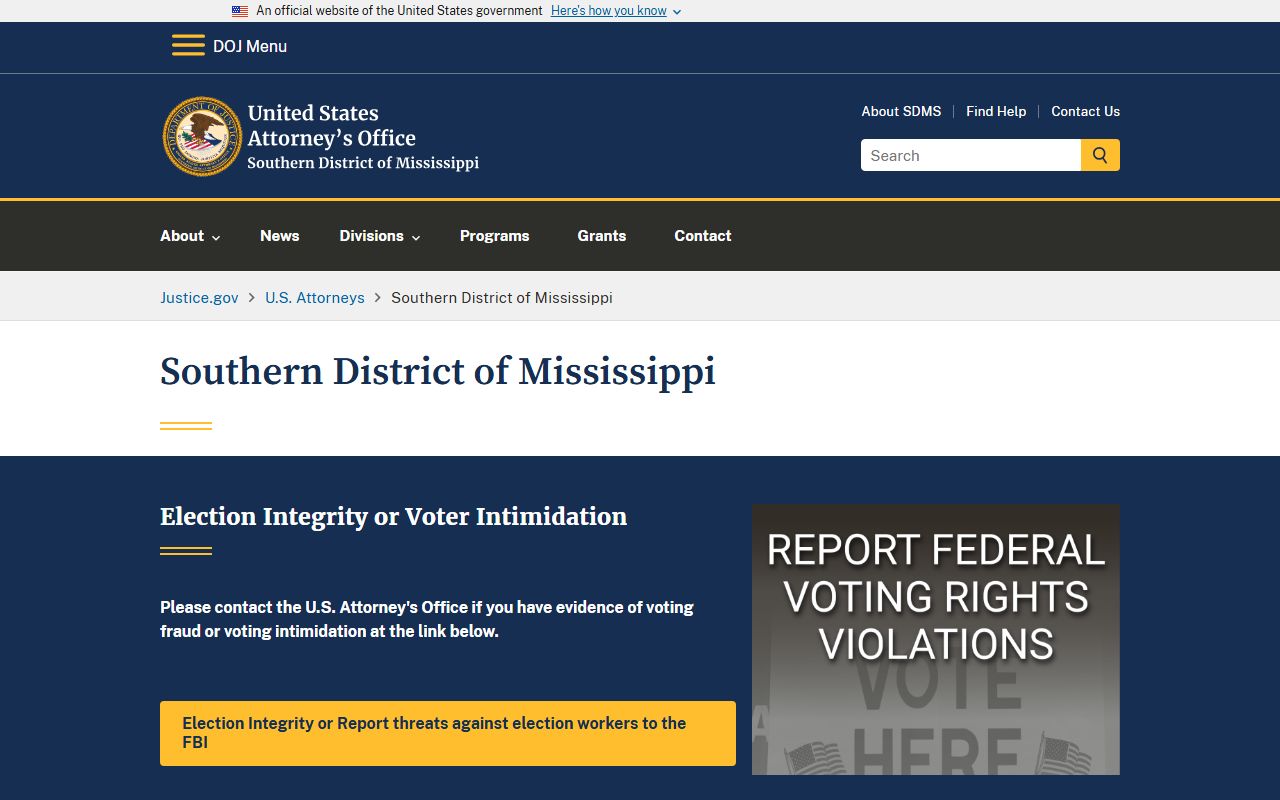
That office prosecutes federal matters in the Southern Division at Gulfport, so a federal docket is searched through the federal court system rather than the county clerk.
Charges vs. Convictions
Being charged is not the same as being convicted. A criminal court record can show charges that were later dropped, dismissed, or ended in an acquittal. A charge is an accusation. A conviction is a finding of guilt by plea or by verdict. Both can appear in the same file, so read the disposition before drawing any conclusion about an outcome.
| Charge | Conviction | |
|---|---|---|
| Stage | Accusation | Verdict or plea |
| Burden of Proof | Probable cause | Beyond a reasonable doubt |
| Can Be Undone | Yes, by dismissal or dropped charge | Only by appeal or post-conviction relief |
| Public Record | Yes | Yes |
Reading Dispositions and Sentences
The disposition is the heart of a criminal court record. It tells you how the case or a single charge ended. A file can carry several charges, each with its own disposition. One charge may be dismissed while another ends in a guilty plea. The sentence then sits next to any conviction and spells out what the court ordered.
- Disposition
- The outcome of a case or a charge, such as guilty, dismissed, or acquitted.
- Plea
- The defendant's formal answer to a charge, commonly guilty or not guilty.
- Sentence
- The punishment ordered after a conviction, such as jail, probation, or a fine.
- Bond Revoked
- Release cancelled, often after a missed court date or a new violation.
- Capias
- An arrest process issued for a failure to appear or to enforce a court order.
A bond revocation or a capias in the file can point to an open warrant, which is tracked separately under Hancock County warrant records. Read those entries with the dates, since a later order can lift a hold the file shows earlier.
Sealed vs. Expunged Records
Two outcomes can pull a criminal record out of public view. A sealed record is closed to the general public but still exists. An expunged record is removed from public access under Mississippi law, so public-facing indexes should no longer treat it as an ordinary record. Eligible nonconvictions, dismissals, acquittals, certain misdemeanors, and limited felony convictions may be expunged by petition.
| Sealed | Expunged | |
|---|---|---|
| Visibility | Closed to the general public | Removed from general public access |
| Law Enforcement | Limited access remains | Limited official access may remain |
| How It Happens | By law or court order | By petition under Miss. Code Ann. Section 99-19-71 |
| Eligibility | Set by the governing statute or order | Eligible nonconvictions and limited convictions |
To pursue an expunction, identify the court where the case ended, gather proof of the disposition, and file a petition there under the proper statute. A granted order goes back to the clerk and the listed agencies, then you confirm that public searches no longer show the matter.
Public Access to Criminal Court Records
Mississippi treats most court records as open. The Public Records Act makes records generally available unless an exemption applies, and a public body cannot stall production past seven working days without an explanation. Criminal charging, initial appearances, and case processing also follow the statewide Rules of Criminal Procedure. For a local copy, the request goes to the county, and a copy fee of 50 cents per page applies.
Key Statutes:
Miss. Code Ann. Section 25-61-1 and Section 25-61-5 set the Mississippi Public Records Act and the seven-working-day response rule.
Mississippi Rules of Criminal Procedure govern charging, initial appearances, and how a criminal case is processed.
Note: the online Delta index is a finding aid, and the official courthouse record controls whenever the two do not match.
Restricted Hancock County Criminal Court Records
Some criminal matters are not open to a general search. Youth Court records are confidential under Mississippi law and are shared only with authorized people or by court order. The county Youth Court handles delinquency, supervision, and abuse or neglect cases, and those files do not appear in the circuit criminal index. Expunged matters are also pulled from public view once a court grants the petition.
Other items inside an otherwise public file stay protected. Sealed exhibits, victim and witness details, financial identifiers, and medical or mental health information are withheld or redacted. An ongoing case may also have filings the court has not yet released. When a search comes back empty, the record may exist in a lower court, may be sealed, or may simply not be online yet.
Important: This is a private resource and not a consumer reporting agency under the Fair Credit Reporting Act, so its data cannot be used for employment, credit, or tenant screening.