
How to Search Hancock County Traffic Court Records
There is no single, county-wide traffic database in Hancock County. The record lives with the court that received the citation, so the first step is reading the ticket. Officers from the Mississippi Highway Patrol, the Sheriff's Department, the Hancock County Constable, and the Mississippi Department of Transportation write tickets that go to the Hancock County Justice Court. Officers from a city police force write tickets that stay with that city's municipal court. The ticket names the issuing agency and the court, and that is the office that holds the file.
Before any traffic court records search, pull the paper citation and note a few details. The citation or case number is the key to almost every lookup. The driver name, license number, and citation date help when staff search by hand or over the phone. New tickets do not appear right away, since the court has to enter the citation before it can be found online.
- Citation or case number - printed on the ticket and used by every payment portal.
- Issuing agency - tells you Justice Court or a city municipal court.
- Driver license number - useful when a clerk searches the file by hand.
- Citation date - the clock for when a record becomes searchable.
Once the court is clear, the search is simple. County and state tickets route to Justice Court and its online payment search. City tickets route to Bay St. Louis, Waveland, or Diamondhead. The sections below break out each venue, the lookup method it uses, and how to pay or contest the charge.
Which Courts Handle Hancock County Traffic Cases
Hancock County traffic venue is split by who wrote the ticket and where the stop happened. The Justice Court sits at the Public Safety Complex and takes citations from the county and state agencies that patrol highways and unincorporated areas. Bay St. Louis, Waveland, and Diamondhead each run a municipal court for tickets written by their own police inside city limits. A DUI or other serious charge can begin in one of these lower courts and later move up if it reaches felony level.
The table sets out each court, the tickets it handles, and where to reach it. Use it to match a citation to the right office before searching or paying.
| Court | Traffic Cases Handled | Address & Phone |
|---|---|---|
| Hancock County Justice Court | Highway Patrol, Sheriff, Constable, and MDOT citations | 8450 Highway 90, Bay St. Louis, MS 39520; 228-467-5573 |
| Bay St. Louis Municipal Court | Bay St. Louis city police citations and ordinance cases | Office 688 Hwy 90; court at 598 Main Street; 228-467-9068 |
| Waveland Municipal Court | Waveland city police citations and ordinance cases | 1602 McLaurin Street, Waveland, MS 39576; 228-467-3669 |
| Diamondhead Municipal Court | Diamondhead city police citations and ordinance cases | 5000 Diamondhead Circle, Diamondhead, MS 39525; 228-222-4626 |
Hancock County Justice Court Citation Lookup
County and state traffic tickets are handled by the Hancock County Justice Court at 8450 Highway 90 in Bay St. Louis. The county also points drivers to an nCourt citation search for looking up and paying a ticket online. The search needs the citation or case number, not a name. Payment can run by card over that portal, by phone, or in person at the court counter.
A live look at the Justice Court payment search appears below, linked to the official nCourt portal.
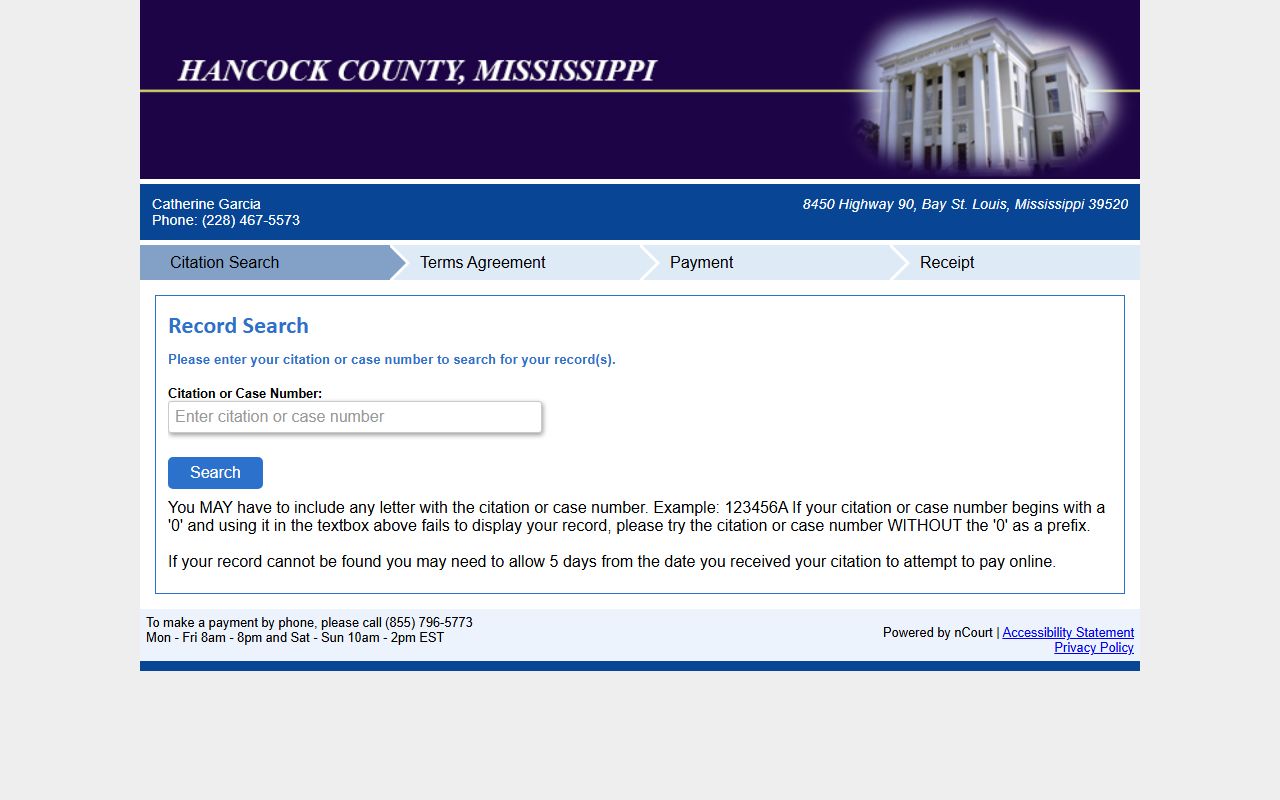
The portal moves from search to a terms screen, then payment, then a receipt. The fields are narrow, so the format matters. Include any letter that prints with the citation or case number. If the number starts with a zero and the search comes back empty, run it again with the leading zero dropped. The table lists what the lookup asks for.
| Field Label | Type | Required | Options / Format Notes |
|---|---|---|---|
| Citation or Case Number | Text | Yes | Include any letter in the number; if it begins with 0 and fails, retry without the leading 0. |
| Search / continue | Button | n/a | Moves to the Terms Agreement, then Payment, then Receipt. |
| Phone payment | Phone channel | n/a | 855-796-5773; Mon-Fri 8 a.m.-8 p.m.; Sat-Sun 10 a.m.-2 p.m. EST. |
Timing trips many people up. A new ticket may not show online until about five days after the citation date, and the county suggests calling the court for status if ten days pass with no record. Justice Court takes cash, money order, and cashier's check, plus card payments by phone or through nCourt.
Note: A traffic ticket that cannot be found online soon after the stop usually means the citation has not been entered yet, not that it was dismissed.
City Traffic Tickets in Hancock County Towns
Tickets written by city police stay inside that town's municipal court, and each of the three cities runs its court a little differently. Bay St. Louis keeps its court office on the first floor of City Hall at 688 Highway 90, but holds court at the Conference Center, 598 Main Street, on Fridays at 10 a.m. The Bay St. Louis Municipal Court can be reached at 228-467-9068, and a Tyler online payments portal handles violations. That portal still tells drivers to confirm court dates with the court department, since failure to appear can lead to an arrest warrant.
Waveland runs its court out of the Police Department at 1602 McLaurin Street. The Waveland Municipal Court clerk line is 228-467-3669, and the payment system also lists 228-466-0042 with office hours of 8 a.m. to 4:30 p.m., Monday through Friday. Card payments go through the city's nCourt portal, shown below from the official Waveland payment page.
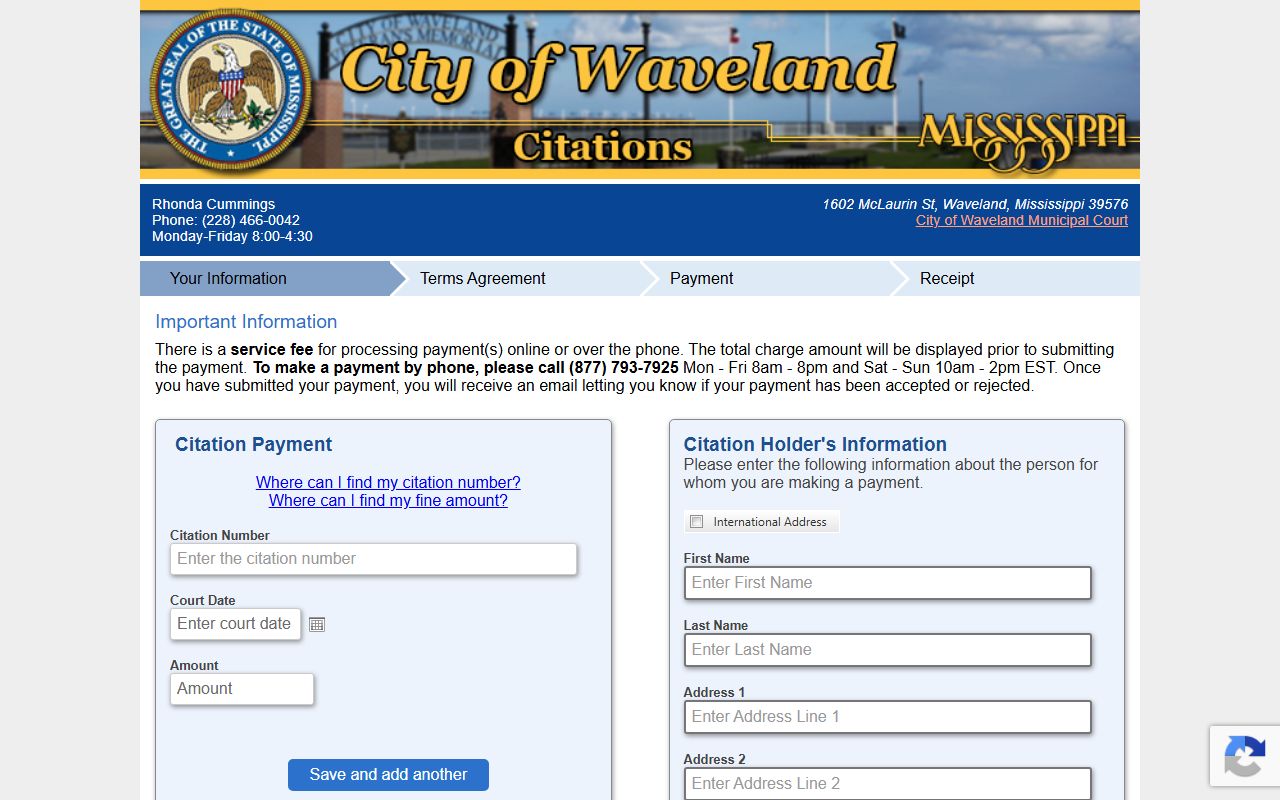
The Waveland portal asks for citation details before it routes a card payment, the same pattern the county uses. Diamondhead handles its own tickets through the Diamondhead Municipal Court at 5000 Diamondhead Circle. Court Clerk Lisa McSwain can be reached at 228-222-4626, extension 1801, and the city page carries pay-a-fine and court-calendar links.
The Diamondhead court page is shown here from the official city court page.
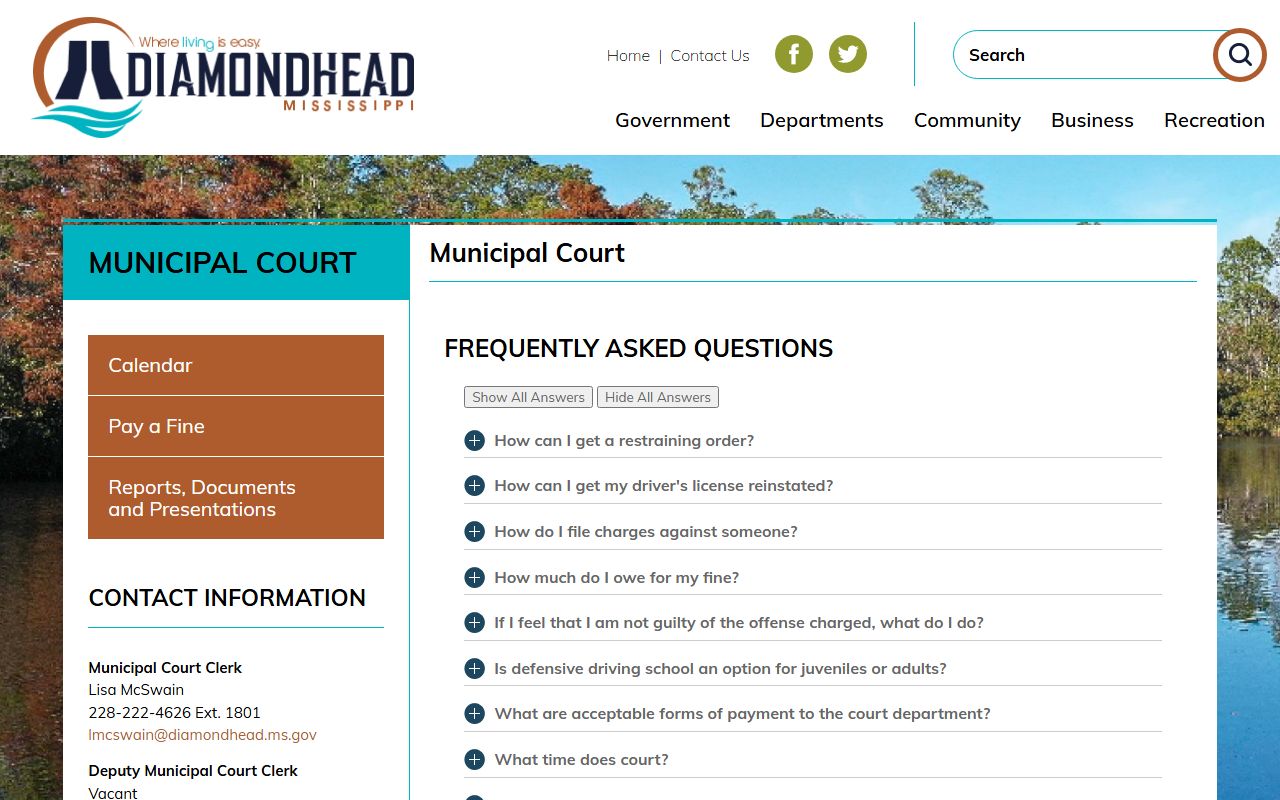
Each city court answers only for its own tickets, so a Waveland clerk cannot clear a Bay St. Louis citation. Match the ticket to the town named on it, then call or pay through that court alone.
Types of Hancock County Traffic Cases
Traffic citations in Hancock County cover far more than speeding. The same courts that take a simple fine also handle charges that carry a court date and the risk of a warrant. Sorting a ticket by type helps a driver judge whether it can be paid outright or needs an appearance.
- Moving violations - speeding, running a signal, careless or reckless driving, and similar charges that affect a driving record.
- License and insurance - driving without a valid license, expired tags, or no proof of insurance.
- Equipment violations - faulty lights, worn tires, or other vehicle defects an officer cites.
- Commercial vehicle - citations against drivers operating under a commercial license, which carry extra weight.
- Serious offenses - DUI and other charges that begin as traffic stops but proceed as criminal cases.
County and state tickets in these classes land in Justice Court, while a city stop sends them to the matching municipal court. The charge text on the citation, paired with the issuing agency, points to the right venue.
What Hancock County Traffic Records Show
A traffic court file tracks one citation from the stop through its outcome. The exact layout varies between Justice Court and the city courts, but the core fields stay consistent. A lookup typically returns the identifying number, the charge, the scheduled court date, and the money owed, plus whatever plea or disposition has been entered. The table breaks down the fields a Hancock County traffic record commonly shows.
| Field | What It Shows |
|---|---|
| Citation or Case Number | The court-assigned identifier used to search and pay the ticket. |
| Charge / Statute | The traffic offense cited, such as speeding or no insurance. |
| Issuing Agency | Highway Patrol, Sheriff, Constable, MDOT, or a city police force. |
| Court Date | The scheduled appearance or response deadline for the citation. |
| Plea / Disposition | How the case resolved: paid, dismissed, or otherwise decided. |
| Fine and Costs | The fine amount plus court costs and any added fees. |
| Warrant / FTA Status | Whether a failure-to-appear flag or warrant is tied to the citation. |
What a court file does not show is the license-side fallout. Points, suspensions, and the long-term driving history sit on the state driver record, a separate file kept by the Mississippi Department of Public Safety. The court tracks the case; the state tracks the license.
Searching by Citation Number or Name
The Justice Court nCourt search runs on the citation or case number alone. It does not offer a name search, so a driver who has lost the ticket should call the court at 228-467-5573 for the number rather than guess. The city portals follow a similar pattern, asking for citation details before they route a payment. None of these tools is built to browse by driver name the way a full case index might.
Citation-number lookups fail for small reasons more than missing records. The number may carry a letter that has to be typed in. A leading zero can break the search, so dropping it often fixes a no-result screen. And a brand-new ticket simply may not be loaded yet. When the number is right and the record still will not appear, the citation date and a phone call to the clerk are the fastest backup.
Note: The county advises waiting about five days for a ticket to post online and calling the court for status if ten days pass without a record showing up.
How to Pay or Contest a Traffic Ticket
Every Hancock County ticket follows the same broad path: find the court, confirm the citation is in the system, then either pay or set up a court date. Paying admits the charge and closes the case. Contesting means appearing before the judge, so the contact has to happen before the scheduled date. The steps below lay out the order.
- Read the citation to find the court. County and state agencies route to Justice Court; city police route to that city's municipal court.
- Give the ticket time to enter the system. Justice Court records may take five days online, and the county suggests calling for status after ten days.
- Search by citation or case number. Include any suffix letters, and retry without a leading zero if the first search fails.
- To pay, follow the nCourt or Tyler portal terms, or pay by phone or in person where the court offers it.
- To contest or ask for more time, contact the court clerk before the court date. Bay St. Louis notes extensions are not routinely granted and should be raised in person.
- If a court date is missed, call the issuing court at once, since failure to appear can trigger an arrest warrant.
- Separately check the state driver record if the ticket affects a license, insurance, a commercial license, or reinstatement.
Failure to Appear and Traffic Warrants
Skipping a traffic court date is the fastest way to turn a fine into a warrant. Each court issues its own bench warrants, so a missed Justice Court date and a missed municipal date are handled by different offices. Bay St. Louis warns plainly that failure to appear can result in an arrest warrant, and the other courts follow the same rule. There is no public county-wide warrant list, which makes the issuing court the place to check.
Clearing a traffic warrant means going back to the court that set it. Call that court, ask what it takes to recall the warrant, and confirm whether a payment, an appearance, or a bond is needed. Do not assume one court can lift another's warrant. After paying or appearing, verify the recall with the issuing court before treating the matter as closed.
Important. A municipal warrant can only be cleared by the city court that issued it. The Circuit Clerk and the Justice Court cannot recall a Bay St. Louis, Waveland, or Diamondhead bench warrant.
Court Traffic Record vs State Driver Record
The most common mix-up in any traffic court records search is treating the court file and the driver record as one thing. They are two separate records, kept by two separate offices, and a driver often needs both. The court file shows what happened with a single citation. The Mississippi driver record, also called a motor vehicle record or MVR, shows the license-level history that the Department of Public Safety keeps over time.
The state driver self-service portal is shown here from the official DPS Driver Self-Service page.

The comparison below sets the two records side by side, including where each lives and how to fix a mistake in it.
| Court Traffic Record | State Driver Record (MVR) | |
|---|---|---|
| Record source | Justice Court or a city municipal court | Mississippi Department of Public Safety |
| What is in it | Citation number, charge, court date, plea, fine, warrant status | License status, convictions reported to DPS, suspensions, reinstatement |
| Where to access | The issuing court counter or its payment portal | DPS Driver Self-Service or the Driver Service Bureau MVR page |
| How to correct errors | Contact the clerk of the court that holds the citation | Contact the DPS Driver Service Bureau about the driving record |
A dismissed citation in the court file does not automatically tidy up the driver record, and a clean payment can still post points to the license. Drivers who care about insurance or license status should check both files, not just one.
Buying a Mississippi Motor Vehicle Record
The driver record comes from the state, not from any Hancock County court. The Mississippi DPS Motor Vehicle Record page sells a one-time view of a current driving record. The DPS page says the driver license is needed to finish the request, and the purchased record stays open for up to 24 hours, so it should be printed from the confirmation screen.
The MVR purchase page is shown below from the official DPS MVR page.
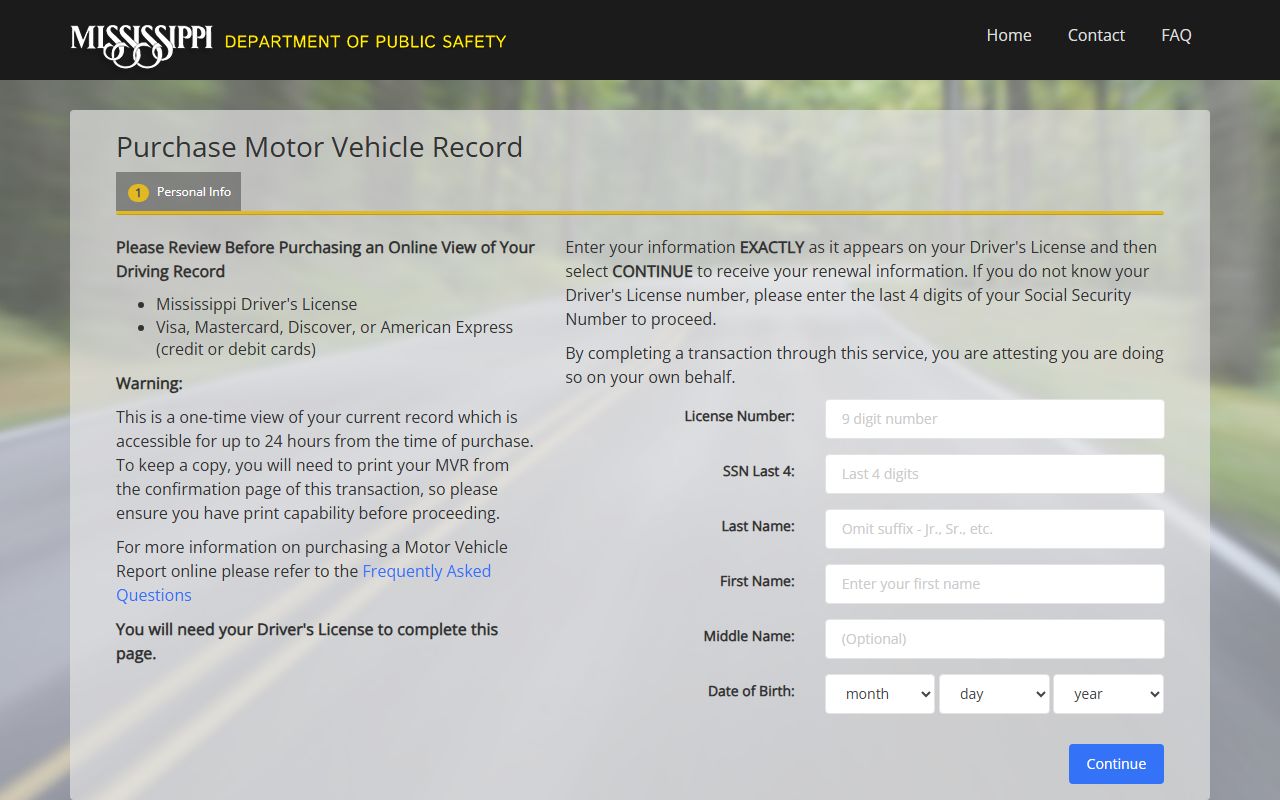
For a record that must be accepted as official, the DPS Driver Service Bureau sells a certified copy and offers a mail option. What the MVR request asks for is short.
- Driver's license
- The DPS MVR page says the license is needed to complete the request.
- Account and payment
- The MVR is a one-time view available for up to 24 hours, so print it from the confirmation page.
- Certified copy
- The Driver Service Bureau lists an online certified copy at $14.31.
Crash Reports Are a Separate Record
A crash report is not a traffic citation and not a driver record. It is the officer's account of an accident, and it travels through its own channel. The Hancock County Sheriff's Office links a crash-report vendor for pulling reports tied to its agency, and DPS handles crash reports for incidents its troopers worked.
The crash-report request page is shown here from the official vendor link on the sheriff site.
A driver involved in a wreck may need all three records at once: the crash report for the accident, the court file for any citation written at the scene, and the driver record for license effects. Each comes from a different office, so plan to make more than one request.
CDL, DUI, and Serious Traffic Cases
Some traffic charges carry weight far beyond a fine. Commercial license holders face stricter handling, since convictions reported to the state can reach a CDL regardless of how the local case resolves. No Hancock-specific commercial deferral policy was published in official sources, so a CDL driver should confirm the local court's practice and check the state driver record for any reported conviction.
DUI and other serious offenses can start as a traffic stop but proceed as criminal matters in Justice Court or a municipal court, and a felony-level case can move to Circuit Court. Because the file then reads as a criminal case rather than a simple citation, the disposition and any sentence sit with the criminal docket. Drivers tracing a DUI outcome can follow it through the Hancock County criminal court records, while the license side stays with DPS.
Note: License consequences for a CDL or DUI run through DPS even when the local court closes the case, so check the driver record as well as the court file.
Public Access to Hancock County Traffic Records
Mississippi treats court records as open unless a specific law makes them confidential, and traffic files generally fall on the public side. When an online portal does not show what a driver needs, the fallback is the clerk of the court that holds the citation, by phone, in person, or by a written records request to the county. Certified copies and any sealed or expunged matter follow courthouse-specific rules.
Key Authority:
Mississippi Public Records Act, Miss. Code Ann. Title 25, Chapter 61 - makes public records generally available, with responses owed within seven working days.
Hancock County Public Records Request Form - routes county requests to the County Administrator at a copy fee of 50 cents per page.
For broader case lookups beyond a single citation, the county's general Hancock County court records resources point to the right office for civil, criminal, and chancery files.
Fees for Traffic and Driver Records
Copy fees split between the courts and the state, matching the split in the records themselves. County copies run through the Hancock County records-request process, while the certified driving record carries a set state price. The table gathers the documented charges.
| Item | Amount |
|---|---|
| County record copy, per page | $0.50 |
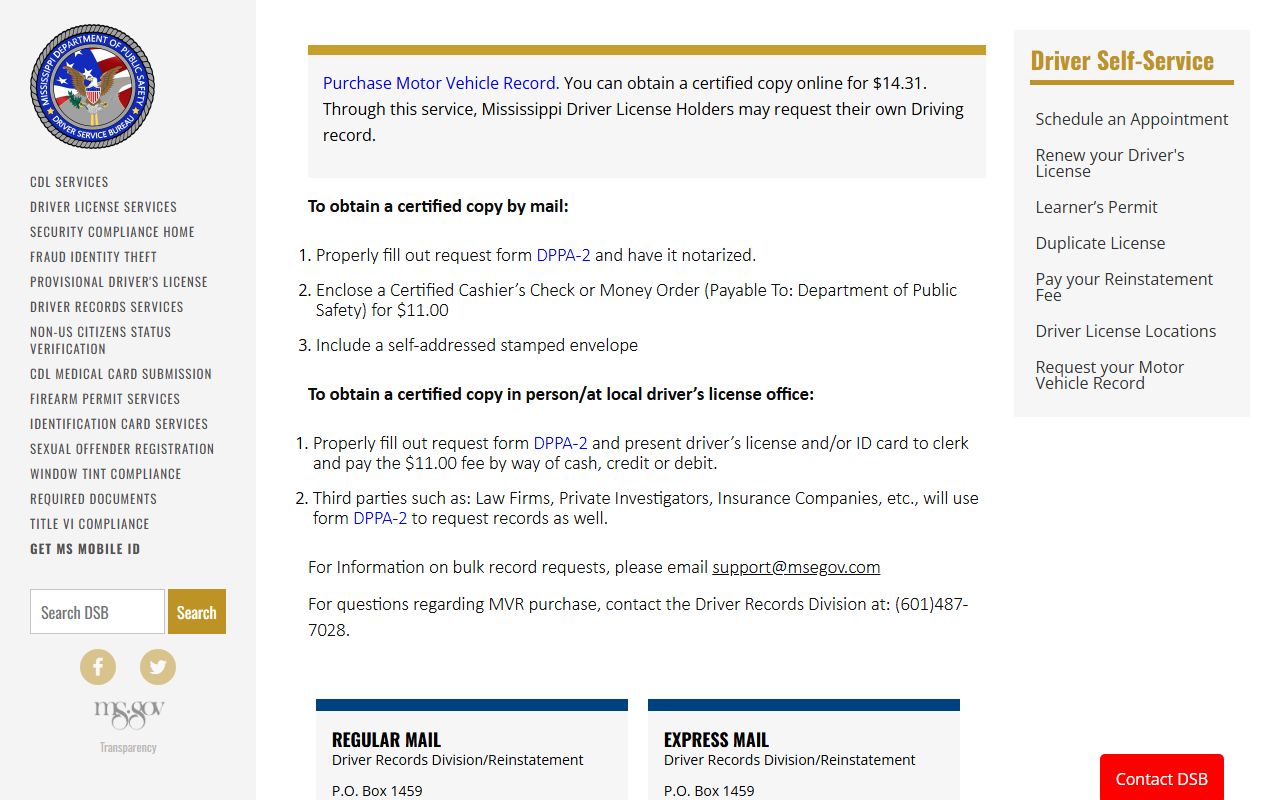
| Certified Mississippi driving record (online) | $14.31 |
| Justice Court ticket payment | Fine and court costs as set by the court |
| Phone card payment (Justice Court) | 855-796-5773 during posted hours |
The certified driving record price comes from the DPS Driver Service Bureau record page, shown below.
Court costs ride on top of the base fine, and the exact total appears once the citation posts to the portal. A specific Hancock County traffic copy fee beyond the general 50-cents-per-page county rate was not published in official sources, so the clerk of the issuing court is the place to confirm a certified court-file copy.